

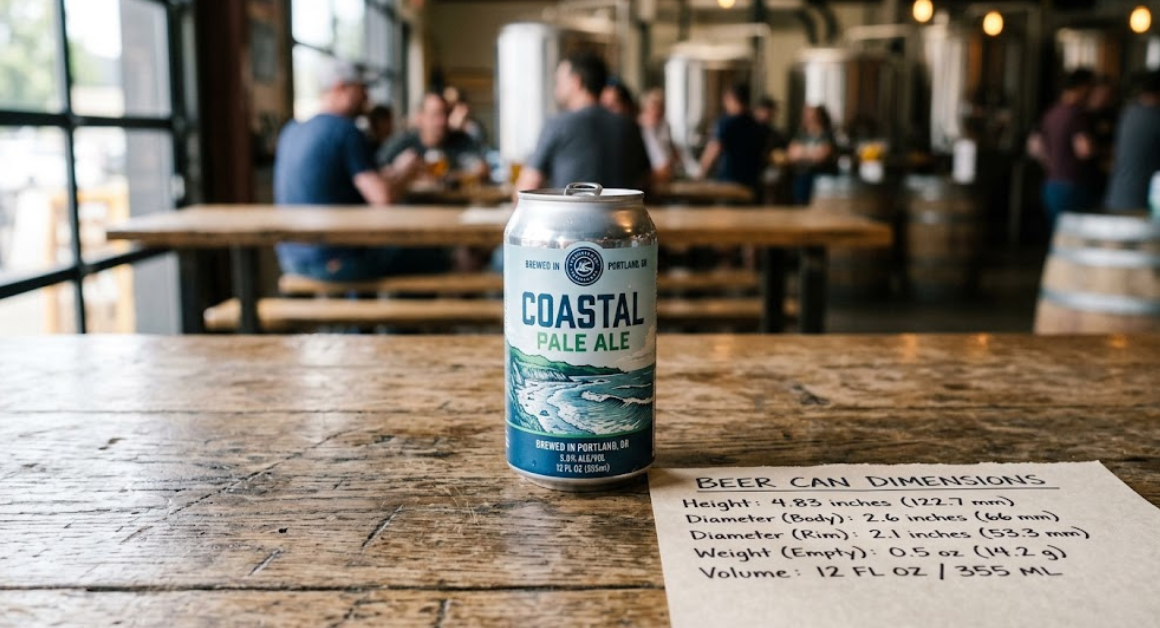
Have you ever noticed that some beer cans are short and wide, while others are tall, slim, and noticeably different in shape? These differences aren’t just about appearance. Beer can dimensions affect how much a can holds, how easily it fits into a cooler, how manufacturers package it, and how much space it takes up in a refrigerator.
Although the familiar 12-ounce beer can is still one of the most common sizes in the United States, it isn’t the only option. You’ll also find 16-ounce tallboys, 19.2-ounce cans, 24-ounce cans, and larger formats designed for different markets and drinking occasions.
In this guide, we’ll explore standard beer can sizes, their typical height and diameter, how US and international measurements compare, and what to consider when choosing cans for storage, packaging, or product design.
What Are the Standard Beer Can Dimensions?
In the United States, a standard 12-ounce beer can typically measures approximately 4.8 inches tall and 2.6 inches in diameter. These dimensions can vary slightly by manufacturer and can design, so they should be treated as general estimates rather than universal specifications.
Beer cans are usually made from lightweight aluminum. Their cylindrical shape makes them easy to stack, transport, store, and chill, while the narrow top and rolled rim help create a practical drinking opening.
Here is a quick overview of common beer can sizes and their approximate dimensions.
| Beer can size | Approximate height | Approximate diameter |
|---|---|---|
| 8.4 oz (250 mL) | 4.1 in | 2.1 in |
| 12 oz (355 mL) | 4.8 in | 2.6 in |
| 16 oz (473 mL) | 6.2 in | 2.6 in |
| 19.2 oz (568 mL) | 6.9 in | 2.6 in |
| 24 oz (710 mL) | 7.2 in | 3.0 in |
Note: These are illustrative estimates for common can formats. Actual dimensions vary by can manufacturer, body profile, and product design. The 8.4-ounce format is also more commonly associated with energy drinks and other beverages than with mainstream beer.
If you’re measuring a can for a cooler, custom packaging, a product listing, or a storage shelf, check the exact product specifications whenever a close fit matters.
Standard 12 oz Beer Can Dimensions
The 12-ounce beer can is a familiar sight in American grocery stores, convenience stores, restaurants, and sporting venues. Its compact size makes it convenient for individual servings and multipack packaging.
Typical measurements are:
- Capacity: 12 US fluid ounces
- Metric capacity: Approximately 355 mL
- Height: Around 4.8 inches
- Body diameter: Around 2.6 inches
- Shape: Cylindrical, with a narrower top and a slightly contoured base
The dimensions may differ slightly between domestic beer brands and imported products. Even cans that hold exactly the same amount of beer don’t necessarily share the same height and width.
Why Is the 12 oz Beer Can So Common?
There are several practical reasons for its popularity.
First, a 12-ounce can provides a convenient single-serving format. Second, its dimensions work well with standard multipack cartons, refrigerator shelves, and many beverage holders. Finally, its established place in the US market makes it a familiar format for breweries, retailers, and consumers.
The volume is also easy to compare with other beverage containers, which makes the 12-ounce format useful when planning inventory or calculating the amount of liquid in a case.
16 oz Beer Can Dimensions: The Tallboy
A 16-ounce beer can, commonly called a tallboy in the United States, holds one-third more beer than a 12-ounce can. It’s especially common for craft beer, pale ales, India pale ales (IPAs), and other specialty brews.
A typical 16-ounce can measures approximately:
- Capacity: 16 US fluid ounces
- Metric capacity: Approximately 473 mL
- Height: Around 6.2 inches
- Diameter: Around 2.6 inches
Many 16-ounce cans use a similar diameter to standard 12-ounce cans but have a taller body. This allows breweries to offer more product without making the can significantly wider.
However, not every 16-ounce can follows the same profile. Some manufacturers use different body shapes or proportions, so the actual dimensions depend on the packaging format.
12 oz vs. 16 oz Beer Can Dimensions
The difference between these two popular sizes is straightforward.
| Feature | 12 oz can | 16 oz can |
|---|---|---|
| Capacity | 355 mL | 473 mL |
| Typical height | 4.8 in | 6.2 in |
| Typical diameter | 2.6 in | 2.6 in |
| Relative capacity | Standard | 33% more |
The 16-ounce can is a useful option when you want a larger serving in a familiar cylindrical package. The 12-ounce can, on the other hand, is shorter and may fit better in compact storage spaces.
19.2 oz Beer Can Dimensions
The 19.2-ounce beer can is a larger single-serving format commonly found in convenience stores and retail outlets in the United States. Sometimes called a stovepipe can, it holds about 568 mL.
Its approximate dimensions are:
-
Capacity: 19.2 US fluid ounces
-
Metric capacity: Approximately 568 mL
-
Height: Around 6.9–7.1 inches
-
Diameter: Around 2.6–2.7 inches
The exact measurements depend on the can design. For example, Cask Global Canning Solutions lists a 19.2-ounce format with a standard 211 body diameter and a 707 height code, corresponding to approximately 7.07 inches.
Compared with a 12-ounce can, this format holds 60% more liquid. Its taller shape can be useful for packaging larger servings without substantially increasing the can’s width.
24 oz Beer Can Dimensions
A 24-ounce beer can holds twice as much liquid as a standard 12-ounce can. It is a familiar larger format in some US retail markets, particularly for individual cans sold at convenience stores.
The capacity is approximately 710 mL, but the exterior dimensions depend on the packaging format. Some cans are taller versions of a standard-width design, while others have a wider body.
For planning purposes, measure the actual can rather than relying on a single universal height or diameter. This is particularly important when designing display racks, refrigerator compartments, and custom packaging.
330 mL and 500 mL Beer Can Dimensions
Outside the United States, 330 mL and 500 mL beer cans are especially common. Their dimensions are worth understanding if you buy imported beer or work with international beverage packaging.
330 mL beer can
Approximately 11.2 US fluid ounces
-
Height: 4.5–4.6 inches
-
Body diameter: 2.6 inches
-
Capacity: 330 mL
This is a widely used standard can size in many international markets.
500 mL beer can
Approximately 16.9 US fluid ounces
-
Height: 6.6 inches
-
Body diameter: 2.6 inches
-
Capacity: 500 mL
This larger format is common in several European markets.
A 500 mL can holds about 41% more beer than a 355 mL can. Despite the difference in capacity, both may use a similar body diameter, with the larger can gaining volume mainly through additional height.
Beer Can Dimensions in Inches and Millimeters
If you’re comparing packaging specifications, metric measurements can be more precise and easier to use with manufacturing drawings.
| Can size | Height (approx.) | Body diameter (approx.) |
|---|---|---|
| 330 mL | 115 mm | 66 mm |
| 355 mL (12 oz) | 122 mm | 66 mm |
| 473 mL (16 oz) | 157 mm | 66 mm |
| 500 mL | 168 mm | 66 mm |
| 19.2 oz (568 mL) | 180 mm | 66 mm |
These reference dimensions are based on standard can formats published by beverage packaging suppliers.
One important detail: the dimensions in this table describe standard-width cans. Sleek and slim cans can have substantially smaller diameters and different heights even when their capacities are similar.
Standard vs. Sleek vs. Slim Beer Cans
Not all beer cans have the familiar short, cylindrical shape. Manufacturers also use different body profiles to achieve a particular appearance or packaging requirement.
Standard cans
The conventional format used for many mainstream beers, soft drinks, and other beverages. Standard bodies are commonly around 66 mm (2.6 inches) in diameter.
Sleek cans
These have a narrower, taller appearance than standard cans. A common reference body diameter is approximately 57 mm (2.25 inches), although exact profiles vary.
Slim cans
These have an even narrower profile, with some common formats measuring around 53 mm (2.1 inches) in body diameter. They are more strongly associated with energy drinks and specialty beverages than with conventional beer.
Packaging suppliers distinguish these formats by body diameter and height, not simply by the amount of liquid they hold.
If you’re choosing a can for a craft beer or specialty beverage, consider the overall dimensions as well as the capacity. A sleek can may look taller and more premium, while a standard can may fit existing packaging and filling equipment more easily.
How to Measure Beer Can Dimensions Correctly
Measuring a beer can is simple, but the method matters if you need accurate figures for packaging, storage, or product design.
Follow these steps:
-
Measure the height. Place the can upright on a flat surface and measure from the bottom to the top of the lid.
-
Measure the body diameter. Measure straight across the widest part of the cylindrical body, avoiding the narrower neck and rolled rim.
-
Measure the circumference if needed. Wrap a flexible measuring tape around the body, or calculate circumference by multiplying the diameter by pi.
-
Record the capacity separately. Don’t confuse the can’s liquid capacity with its external physical volume.
-
Check the dimensions of multiple cans if necessary. Different production runs or packaging formats may have slightly different measurements.
Why Can Circumference Matters for Labels
If you’re designing a wraparound beer can label, the circumference is particularly important because it determines the available width around the can.
For example, a can with a body diameter of 66 mm has a circumference of approximately 207 mm, or 8.15 inches.
The formula is:
However, that calculation provides the theoretical circumference, not necessarily the final label dimensions. Printing methods, overlap requirements, seam placement, and the shape of the can can affect the artwork specifications.
Always request the manufacturer’s or packaging supplier’s dieline before approving a label for production.
Frequently Asked Questions About Beer Can Dimensions
1. What are the dimensions of a standard beer can?
A typical US 12-ounce beer can is approximately 4.8 inches tall and 2.6 inches in body diameter. Exact dimensions vary by manufacturer and can profile.
2. How tall is a 12 oz beer can?
A standard 12-ounce beer can is approximately 4.8 inches (122 mm) tall. Some designs may be slightly taller or shorter.
3. What is the diameter of a standard beer can?
Many standard-width beer cans have a body diameter of approximately 2.6 inches (66 mm). The top opening is narrower than the body, so the lid diameter should not be confused with the can’s overall body diameter.
4. How tall is a 16 oz beer can?
A typical 16-ounce tallboy can is approximately 6.2 inches (157 mm) tall and around 2.6 inches (66 mm) in diameter.
5. How big is a 19.2 oz beer can?
A 19.2-ounce can holds approximately 568 mL. A common standard-width format is about 7.1 inches tall, although dimensions can differ by manufacturer.
6. Are beer cans measured by height or capacity?
Both measurements matter, but they describe different things. Capacity indicates how much liquid the can holds, while height and diameter describe its external dimensions.
7. How many millimeters wide is a standard beer can?
A conventional standard-width beverage can has a body diameter of approximately 66 mm. Slim and sleek formats are narrower.
8. What is the difference between a 330 mL and a 355 mL beer can?
A 355 mL can holds 25 mL more liquid than a 330 mL can. Both commonly use a standard-width body, but their heights can differ slightly.
9. Do all 12-ounce beer cans have the same dimensions?
No. Although many standard 12-ounce cans are approximately 122 mm tall and 66 mm wide, sleek cans and other specialty designs have different proportions.
10. What beer can dimensions should I use for custom packaging?
Use the exact specifications for the can you intend to purchase. Confirm its height, maximum body diameter, lid profile, and label or sleeve requirements with your packaging supplier before finalizing the design.
Conclusion
Understanding beer can dimensions helps you compare popular beer sizes, plan storage space, select packaging, and avoid mistakes when measuring containers. A standard 12-ounce can is approximately 4.8 inches tall and 2.6 inches wide, while a 16-ounce tallboy is taller and a 19.2-ounce can provides a larger serving.
International formats such as 330 mL and 500 mL cans add further variety, and sleek or slim designs demonstrate why capacity alone doesn’t determine a can’s shape.
For everyday comparisons, these typical measurements are a useful starting point. For custom labels, manufacturing, or tight-fitting storage, always verify the exact dimensions from the can manufacturer.
If you’re researching other beverage containers, explore related guides on soda can dimensions, energy drink can sizes, and aluminum can measurements to make your next packaging or storage decision with confidence.