

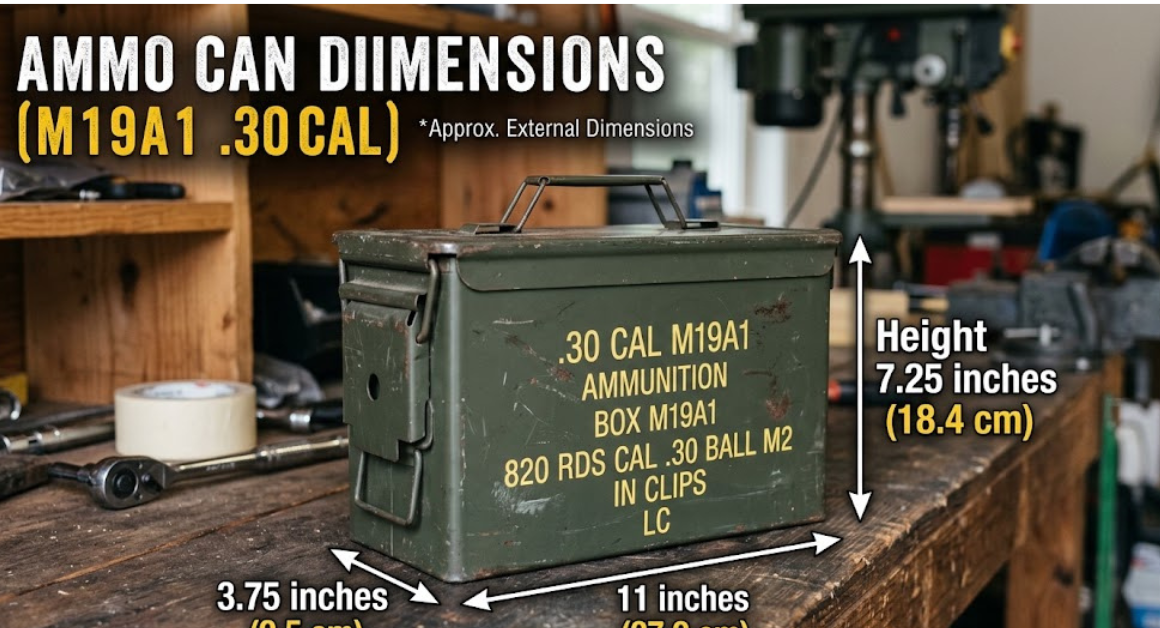
Ammo cans are built to be sturdy, practical, and easy to stack, but not every can has the same dimensions. If you’re planning storage space, organizing equipment, or checking whether a container will fit on a shelf, understanding ammo can dimensions can save you time and prevent sizing mistakes.
The two most familiar military-style steel ammunition cans are the compact .30-caliber M19A1 and the larger .50-caliber M2A1. Other designs include wider Fat 50 cans and larger containers originally designed for different types of military ammunition. Their measurements can vary by manufacturer, production version, and whether the product is a military-surplus can or a modern reproduction.
This guide compares common sizes, explains interior versus exterior measurements, and shows you how to choose a can that fits your storage requirements.
Standard Ammo Can Dimensions Chart
Ammo cans are generally measured by length × width × height. Always check the seller’s measurement order, since some listings put height first or use depth instead of length.
The figures below are representative measurements from published product listings. They are useful for planning, but should not be treated as universal specifications for every can carrying the same label.
| Ammo can type | Approximate exterior dimensions (L × W × H) | Approximate interior dimensions (L × W × H) |
|---|---|---|
| .30 Cal M19A1 | 11.75 × 3.75 × 7 inches | 10 × 3.5 × 6.5 inches |
| .50 Cal M2A1 | 11.75 × 6 × 7.5 inches | 11 × 5.5 × 7 inches |
| Fat 50 | Around 12 × 7–7.5 × 8.5–9 inches | Varies by model |
| M548, often listed for 20mm ammunition | Around 18.75 × 8.5 × 14.5 inches | Around 17.25 × 7.5 × 14 inches |
| M116A2, associated with 40mm ammunition | Around 18.25 × 6 × 9.75 inches | Around 17.25 × 5.5 × 9.5 inches |
Sources and measurement note: The .30 Cal and .50 Cal figures are based on commercial listings for M19A1 and M2A1 cans; the larger-can figures are also published by ammunition and surplus retailers. Dimensions differ across listings, so confirm the exact product before making a tight-fitting holder or storage compartment.
.30 Cal Ammo Can Dimensions (M19A1)
The .30 Cal M19A1 is a narrow, compact metal storage container. Its slim profile makes it useful when shelf width is limited or when a smaller box is easier to carry.
Commonly listed measurements are:
- Exterior length: About 11.75 inches
- Exterior width: About 3.75 inches
- Exterior height: About 7 inches
- Interior length: About 10 inches
- Interior width: About 3.5 inches
- Interior height: About 6.5 inches
These figures are representative rather than guaranteed. Some sellers list slightly different exterior lengths or heights, particularly for reproduction cans and cans measured at different points.
What Makes the .30 Cal Can Different?
Its main advantage is its narrow shape. Compared with a standard .50 Cal can, it takes up less width, making it easier to arrange in tight spaces.
When checking fit, pay attention to the latch and handle as well as the main body. These features may project beyond the box itself and can affect how closely containers can be placed side by side.
.50 Cal Ammo Can Dimensions (M2A1)
The .50 Cal M2A1 is one of the most recognizable military-style ammunition cans. It is wider than the .30 Cal M19A1 and provides more room for general storage.
A commonly published set of measurements is:
- Exterior length: About 11.75 inches
- Exterior width: About 6 inches
- Exterior height: About 7.5 inches
- Interior length: About 11 inches
- Interior width: About 5.5 inches
- Interior height: About 7 inches
These dimensions appear in listings for M2A1-style cans, but an individual product may differ slightly.
Why Interior Dimensions Matter
The outside measurements tell you how much room the can occupies. The inside measurements tell you how much usable space is available.
For example, a can listed as 11.75 inches long externally may provide only around 11 inches of interior length. Wall thickness, folded edges, the lid, and the sealing arrangement all affect the space available inside.
If you’re choosing a can for tools or other equipment, compare the interior dimensions with the actual items you want to store.
Fat 50 Ammo Can Dimensions
A Fat 50 can is a wider variation of the familiar .50 Cal-style container. It is often selected when the standard M2A1’s width is not sufficient for the intended contents.
Published listings commonly place Fat 50 cans around 12 inches long, 7–7.5 inches wide, and 8.5–9 inches tall. However, these figures are less consistent than the commonly listed M2A1 dimensions, and the name alone does not guarantee one exact size.
Before purchasing, verify:
- The exact product model or manufacturer part number.
- Exterior length, width, and height.
- Interior clearance beneath the lid.
- Whether the handle and latch affect the intended fit.
- Whether the seller is describing a military-surplus item or a reproduction.
This extra check is especially important when the can must fit inside a drawer, rack, cabinet, or vehicle compartment.
Larger Military Ammo Can Dimensions
Some ammunition containers are considerably larger than the familiar .30 Cal and .50 Cal boxes. Two examples found in commercial listings are the M548 and M116A2 models.
M548 Can
The M548 is associated with 20mm ammunition and is much larger than a standard M2A1 can. One commonly listed set of dimensions is approximately 18.75 × 8.5 × 14.5 inches externally, with an interior around 17.25 × 7.5 × 14 inches. <Cite refs={[“turn645879search2″,”turn645879search5”]}/>
M116A2 Can
The M116A2 is associated with 40mm ammunition. Published commercial dimensions are approximately 18.25 × 6 × 9.75 inches externally and 17.25 × 5.5 × 9.5 inches internally.
These are model-specific containers, not simply larger versions of a standard .50 Cal can. If you are comparing surplus equipment, verify the model identification and the seller’s actual measurements.
Ammo Can Dimensions in Centimeters
If you’re working with metric shelving, cabinets, or storage boxes, converting inches to centimeters makes comparisons easier.
Use this conversion:
1 inch = 2.54 centimeters
Here are approximate exterior measurements for two common can types:
| Can type | Length | Width | Height |
|---|---|---|---|
| .30 Cal M19A1 | 29.8 cm | 9.5 cm | 17.8 cm |
| .50 Cal M2A1 | 29.8 cm | 15.2 cm | 19.1 cm |
These conversions are calculated from the representative inch measurements above. They are not separate manufacturer-certified metric specifications.
When buying from an overseas supplier, check whether the dimensions are rounded to whole centimeters or measured precisely. A few millimeters can make a difference in a snug-fitting compartment.
Exterior vs. Interior Ammo Can Measurements
One of the most common sources of confusion is the difference between a can’s external size and its usable internal space.
Exterior Dimensions
Exterior dimensions measure the container from the outside. They are the most useful measurements for determining whether a can will fit on a shelf, inside a cabinet, or within a storage compartment.
Remember to account for protruding latches, handles, and hinges if the available space is tight.
Interior Dimensions
Interior dimensions describe the available space inside the container. They are more relevant when checking whether an object will fit inside.
The usable space can be reduced by:
- The thickness of the metal walls.
- The shape of the lid and its edges.
- The gasket or sealing arrangement.
- Interior features that extend into the storage area.
Never assume that a can’s exterior length is also its interior length. Check the listing or measure the can directly.
How to Measure an Ammo Can
If a can’s published dimensions are unclear, measuring the actual container is the safest way to confirm its size.
You’ll need a tape measure or ruler. A caliper can help with smaller gaps or more precise measurements.
- Measure the length: Measure the longest horizontal side of the main body.
- Measure the width: Measure across the shorter horizontal side.
- Measure the height: Measure from the base to the highest point of the closed container.
- Check the lid and hardware: Note whether the handle, latch, or hinges extend beyond the body.
- Measure the interior: Open the can and measure the usable length, width, and depth.
- Record the units: Write down whether the measurements are in inches or centimeters, and keep the order consistent.
If you’re planning to place several cans together, measure the widest points rather than just the flat sides. Leave some clearance for easy removal and for hardware that may stick out.
What to Consider Before Choosing an Ammo Can
Dimensions are important, but they are not the only thing to consider when comparing containers.
- Construction: Check the material, seams, and overall condition.
- Lid and seal: Inspect the gasket and closure, especially if moisture resistance matters.
- Condition: Surplus cans may have dents, corrosion, worn seals, or bent latches.
- Weight: A metal container’s weight increases when you add its contents, so consider how it will be moved.
- Fit: Compare both interior and exterior measurements with the intended storage location.
- Product identification: Confirm the model number rather than relying only on terms such as “.30 Cal” or “Fat 50.”
A gasketed lid can help reduce moisture entry, but not every can is guaranteed to be waterproof or airtight. Condition, construction, and the manufacturer’s claims matter.
If the container will be used for ammunition, follow the ammunition manufacturer’s storage guidance and applicable local laws. Keep ammunition secured and away from children and unauthorized users.
Frequently Asked Questions About Ammo Can Dimensions
1. What are the standard ammo can dimensions?
A commonly listed .50 Cal M2A1 can measures approximately 11.75 × 6 × 7.5 inches externally. A .30 Cal M19A1 is around 11.75 × 3.75 × 7 inches. Exact measurements vary by product and seller.
2. How big is a .30 Cal ammo can?
A typical M19A1 listing gives exterior dimensions of approximately 11.75 inches long, 3.75 inches wide, and 7 inches high. Its interior is smaller, commonly listed around 10 × 3.5 × 6.5 inches.
3. How big is a .50 Cal ammo can?
A standard M2A1 is commonly listed at about 11.75 inches long, 6 inches wide, and 7.5 inches high externally. Its interior measurements are often listed around 11 × 5.5 × 7 inches.
4. Are .30 Cal and .50 Cal ammo cans the same height?
Not always, although commonly published measurements put both models in a similar height range. The most obvious difference is width: the .50 Cal M2A1 is substantially wider than the narrow M19A1. Check the specific product listing for exact measurements.
5. What are ammo can dimensions in centimeters?
Using common exterior measurements, a .30 Cal M19A1 is approximately 29.8 × 9.5 × 17.8 cm, while a .50 Cal M2A1 is approximately 29.8 × 15.2 × 19.1 cm. These are conversions of representative inch measurements, not guaranteed dimensions for every model.
6. Why are interior ammo can dimensions smaller?
The walls, lid construction, folded edges, and sealing components take up space. That’s why the usable interior is smaller than the exterior measurements.
7. Are all military-style ammo cans waterproof?
No. Some are designed with gasketed lids to resist moisture, but condition and construction vary. A damaged seal, corrosion, or a reproduction design can affect how well a container protects its contents.
8. How can I find the exact dimensions of my ammo can?
Look for the model number and manufacturer details, then check the product documentation or seller’s measurements. If those details aren’t available, measure the exterior and interior directly. For a tight fit, include the latch and handle in your measurements.
Conclusion
Understanding ammo can dimensions helps you compare storage containers, plan shelf space, and avoid choosing a box that’s too wide, too tall, or too small inside. The .30 Cal M19A1 is the narrower option, while the .50 Cal M2A1 offers more width. Fat 50 and larger specialized cans use different dimensions, so the model matters.
Use published measurements as a starting point, not a universal guarantee. Before purchasing a can for a precise fit, confirm the exterior size, usable interior space, and any protruding hardware. You can also compare related guides on storage box dimensions and military surplus containers to find a size that suits your space.