

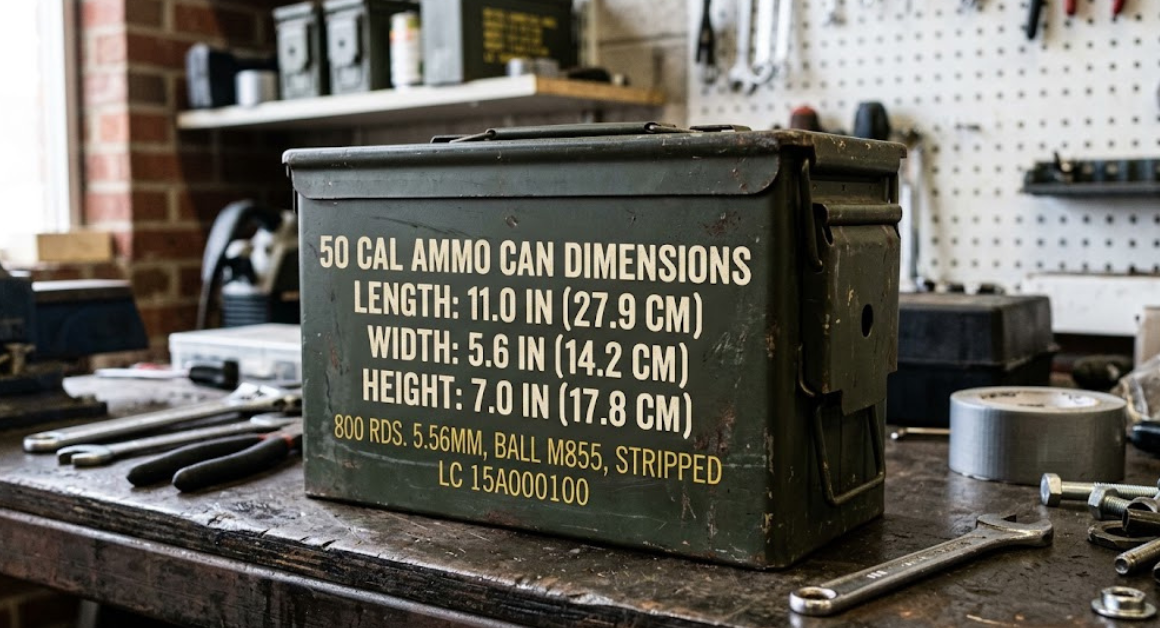
A .50 cal ammo can may look like a simple steel box, but its proportions make it useful for storing and organizing a wide range of equipment. If you’re planning to fit one on a shelf, inside a cabinet, or in a vehicle storage compartment, knowing the exact measurements can save you from buying a can that doesn’t fit.
The standard 50 cal ammo can dimensions most commonly associated with the US military-style M2A1 model are approximately 11.75 inches long, 6 inches wide, and 7.5 inches tall. Its usable interior space is smaller, at roughly 11 × 5.5 × 7 inches.
In this guide, we’ll break down the exterior and interior dimensions, convert the measurements into centimeters and millimeters, compare standard and wider can styles, and explain what to check before purchasing a military-surplus or commercial storage can.
Standard 50 Cal Ammo Can Dimensions at a Glance
The M2A1-style .50 cal ammo can is a rectangular metal container with a hinged lid, a carrying handle, and a locking latch. Although different manufacturers and production versions can vary slightly, the following measurements are a useful reference for the common standard design.
| Measurement | Approximate size |
|---|---|
| Exterior length | 11.75 inches |
| Exterior width | 6 inches |
| Exterior height | 7.5 inches |
| Interior length | 11 inches |
| Interior width | 5.5 inches |
| Interior height | 7 inches |
| Empty weight | About 5.2 pounds |
| Empty weight in metric units | About 2.36 kg |
These specifications are listed for a standard M2A1 .50-caliber-size can by Clean Ammo Cans and Ammoman.
The main takeaway: Use the outside dimensions to check whether the can will fit in your storage space. Use the inside dimensions to determine whether your intended items will fit inside it.
50 Cal Ammo Can Dimensions in Inches, Centimeters, and Millimeters
If you’re comparing products sold in different countries, metric conversions make it easier to understand the size.
| Dimension | Inches | Centimeters | Millimeters |
|---|---|---|---|
| Exterior length | 11.75 in | 29.85 cm | 298.45 mm |
| Exterior width | 6 in | 15.24 cm | 152.4 mm |
| Exterior height | 7.5 in | 19.05 cm | 190.5 mm |
| Interior length | 11 in | 27.94 cm | 279.4 mm |
| Interior width | 5.5 in | 13.97 cm | 139.7 mm |
| Interior height | 7 in | 17.78 cm | 177.8 mm |
Metric measurements are conversions of the commonly listed inch measurements and are rounded for practical use.
These figures are particularly helpful if you’re building a storage shelf, designing a drawer organizer, or checking the available space in a vehicle.
For a snug fit, allow extra room around the can rather than designing a compartment that matches its nominal measurements exactly. Handles, latch hardware, hinges, and manufacturing differences may affect the clearance you need.
Exterior vs. Interior 50 Cal Ammo Can Dimensions
One of the most common mistakes when comparing ammo cans is assuming that the outside measurements describe the space available inside.
They don’t. The steel walls, corners, lid, and sealing surfaces take up room, so the usable interior is smaller than the external footprint.
For the standard M2A1-style can:
- Exterior: Approximately 11.75 × 6 × 7.5 inches
- Interior: Approximately 11 × 5.5 × 7 inches
These measurements are reported by retailers that list the M2A1 can’s specifications.
Why are the interior dimensions smaller?
The container needs enough structural material to form a rigid body and a lid that closes securely. Its interior corners and lid profile may also reduce the usable space compared with a simple rectangular measurement.
That difference matters if you’re trying to store a rigid object. An item that appears to fit based on the can’s outside dimensions may be too long, wide, or tall for the actual interior.
Which measurements should you use?
Use exterior dimensions when checking:
- Shelf and cabinet clearance
- Vehicle storage compartments
- Shipping boxes
- Stacking arrangements
- Storage racks
Use interior dimensions when checking:
- Whether equipment fits inside
- The size of dividers or organizers
- Whether a rigid case can sit inside the can
- The usable space available for general storage
For irregularly shaped objects, remember that the lid’s interior profile and the shape of the corners may affect the fit.
How Tall Is a 50 Cal Ammo Can?
A standard M2A1-style .50 cal ammo can is approximately 7.5 inches (19.05 cm) tall externally. Its listed interior height is around 7 inches (17.78 cm).
That makes it a relatively compact container for a heavy-duty steel box. It can be convenient for shelves and storage areas where a taller container would be awkward.
When measuring height, consider the complete closed container. If you plan to store the can under a shelf, also allow enough space to reach the handle and operate the latch comfortably.
How Wide and Long Is a 50 Cal Ammo Can?
The standard can is approximately 11.75 inches long and 6 inches wide, based on commonly published M2A1 specifications.
Its rectangular footprint is useful for organizing equipment in a cabinet or on a shelf. However, the handle and latch may extend beyond parts of the body, depending on the model and their position.
Before purchasing, check whether the dimensions listed by the seller include protruding hardware. This is especially important if the can needs to slide into a narrow compartment.
How Much Does a 50 Cal Ammo Can Weigh?
A standard empty M2A1-style can weighs approximately 5.2 pounds (2.36 kg), according to product specifications published by Clean Ammo Cans and Arm or Ally.
The actual weight can vary with the model, steel construction, lid design, and condition. Military-surplus cans may also have accumulated paint, replacement parts, corrosion, or other changes during their service life.
Keep in mind that the empty weight is only part of the picture. Anything placed inside adds to the total weight, so consider the intended load when deciding where to store the container and how often you’ll need to move it.
Standard 50 Cal Ammo Can vs. Fat 50 Ammo Can
The phrase “50 cal ammo can” can sometimes cause confusion because sellers offer different container styles under similar descriptions.
The standard M2A1-style can is relatively compact. A wider model, often called a Fat 50, has a different body shape and may provide more interior room, even when its length is similar.
One published comparison lists the standard M2A1 at approximately 11.75 × 6 × 7.5 inches externally, while a Fat 50-style can has a broader body and a different overall height. Exact measurements depend on the specific model.
| Feature | Standard M2A1-style can | Fat 50-style can |
|---|---|---|
| General shape | Compact rectangular box | Wider, roomier rectangular box |
| External dimensions | Commonly about 11.75 × 6 × 7.5 in | Vary by model |
| Interior space | About 11 × 5.5 × 7 in | Varies by model |
| Best measuring approach | Check listed M2A1 dimensions | Confirm the exact product specifications |
Do not assume every Fat 50 can shares identical measurements. If you are purchasing one for a custom storage setup, ask the seller for both the external and interior dimensions.
What Is a 50 Cal Ammo Can Used For?
Although the design originated as an ammunition container, an empty ammo can may also be used for general storage when the intended contents and environment are appropriate.
Common uses include:
- Tool storage: Keeping small hand tools and hardware together.
- Camping supplies: Organizing compact equipment and accessories.
- Vehicle organization: Storing selected emergency or maintenance items.
- Workshop storage: Separating small parts, fasteners, and supplies.
- General equipment storage: Keeping compatible items contained and organized.
The metal body and fitted lid make these cans appealing for rugged storage. However, don’t assume every used can is waterproof or airtight simply because it has a rubber seal. Seal condition, rust, dents, lid alignment, and the latch all affect performance.
If you need protection from moisture, inspect the seal and closure carefully and verify the product’s suitability for that purpose. Avoid using a damaged or contaminated surplus can to store food, drinking water, or other items requiring a clean, food-safe container.
How to Measure a 50 Cal Ammo Can Correctly
If you already own a can, measuring it directly is the best way to confirm its dimensions. This is particularly important for surplus cans, commercial reproductions, or older containers that may differ from a reference specification.
Step 1: Measure the exterior length
Place the closed can on a flat surface. Measure the longest side of the main body, and note whether any handle or latch extends farther.
Step 2: Measure the exterior width
Measure across the shorter side of the body. If the can will fit into a tight space, check the widest point, including any protruding hardware.
Step 3: Measure the exterior height
Measure from the bottom of the can to the highest point of the closed lid. If you plan to open the lid in place, measure the additional clearance required for the lid to swing.
Step 4: Measure the usable interior
Open the lid and measure the internal length, width, and height. Check the corners and lid profile, as these may limit the space available for larger rigid objects.
Step 5: Compare your measurements with the available space
Leave some clearance around the can for easy removal and handling. If you’re building a fitted storage compartment, use the measurements of the exact can rather than relying only on a general online specification.
Is a 50 Cal Ammo Can Waterproof?
Many military-style ammo cans feature a rubber gasket intended to help seal the lid against moisture and dust. However, the presence of a gasket alone does not guarantee that a particular can is waterproof.
Condition makes a difference. A worn gasket, bent lid, damaged latch, rusted seam, or dent near the rim can compromise the seal.
If moisture protection matters, inspect the can carefully and look for the manufacturer’s stated performance claims. Treat old surplus containers as individual items whose condition needs to be checked, rather than assuming all cans provide the same level of protection.
What to Check Before Buying a 50 Cal Ammo Can
Dimensions are important, but they aren’t the only factor worth considering. A can that fits your shelf may still be unsuitable if its lid, seal, or body is damaged.
Before buying, check the following:
- Exact model: Confirm whether it’s a standard M2A1-style can, another variant, or a commercial reproduction.
- Exterior measurements: Check the length, width, and height against your available space.
- Interior measurements: Make sure the usable space accommodates your intended items.
- Empty weight: Consider whether the container will be easy to move.
- Condition: Look for severe rust, dents, damaged hinges, and latch problems.
- Seal condition: If moisture resistance matters, inspect the gasket and lid contact surfaces.
- Seller specifications: Verify whether the listed measurements include the handle and other protruding parts.
Military-surplus products may show wear from storage and use, so photos and condition descriptions are worth reviewing before you make a purchase.
Frequently Asked Questions About 50 Cal Ammo Can Dimensions
1. What are the standard 50 cal ammo can dimensions?
A standard M2A1-style .50 cal ammo can measures approximately 11.75 inches long, 6 inches wide, and 7.5 inches tall externally. Its interior dimensions are about 11 × 5.5 × 7 inches.
2. How tall is a 50 cal ammo can?
A standard M2A1-style can is about 7.5 inches (19.05 cm) tall externally. The usable interior height is approximately 7 inches (17.78 cm).
3. How wide is a 50 cal ammo can?
The standard can is approximately 6 inches (15.24 cm) wide externally. Its interior width is around 5.5 inches (13.97 cm).
4. How long is a 50 cal ammo can?
The commonly listed exterior length of an M2A1-style can is about 11.75 inches (29.85 cm). The interior length is approximately 11 inches (27.94 cm).
5. How much does an empty 50 cal ammo can weigh?
A standard M2A1-style can weighs approximately 5.2 pounds, or 2.36 kilograms, when empty. Weight can vary by model and condition.
6. Are M2A1 and M2A2 ammo cans the same size?
Retailers commonly list M2A1 and M2A2 .50-caliber-size cans with the same nominal exterior and interior dimensions. However, construction details can differ, so check the exact model’s specifications if a precise fit is necessary.
7. What is the difference between a standard 50 cal can and a Fat 50?
A standard M2A1-style can has a compact rectangular shape, while a Fat 50-style container is generally wider and may be taller. The exact measurements depend on the particular model, so verify the seller’s specifications.
8. Are all 50 cal ammo cans exactly the same size?
No. Dimensions may vary between manufacturers, production versions, surplus containers, and commercial reproductions. The standard measurements are a reference, not a guarantee for every can sold under the same general name.
9. How many centimeters long is a 50 cal ammo can?
Using the common exterior length of 11.75 inches, the can is approximately 29.85 centimeters long. The precise measurement depends on the particular container.
10. Can a 50 cal ammo can fit inside a cabinet?
It may fit if the cabinet has enough clearance for the can’s exterior dimensions and any protruding hardware. Check the cabinet’s usable length, width, and height, and account for space needed to open the lid and operate the latch.
Conclusion
The most commonly listed 50 cal ammo can dimensions for a standard M2A1-style container are approximately 11.75 inches long, 6 inches wide, and 7.5 inches tall. The usable interior measures around 11 × 5.5 × 7 inches, and the empty can weighs approximately 5.2 pounds.
These measurements provide a useful starting point for planning storage, organizing equipment, or comparing different containers. Just remember that military-surplus cans, commercial reproductions, and wider Fat 50 models may have different dimensions.
Before buying, confirm the exact model and check both exterior and interior measurements. If you’re building a shelf or custom compartment, measure the actual can and leave enough room for its handle, latch, and lid.