

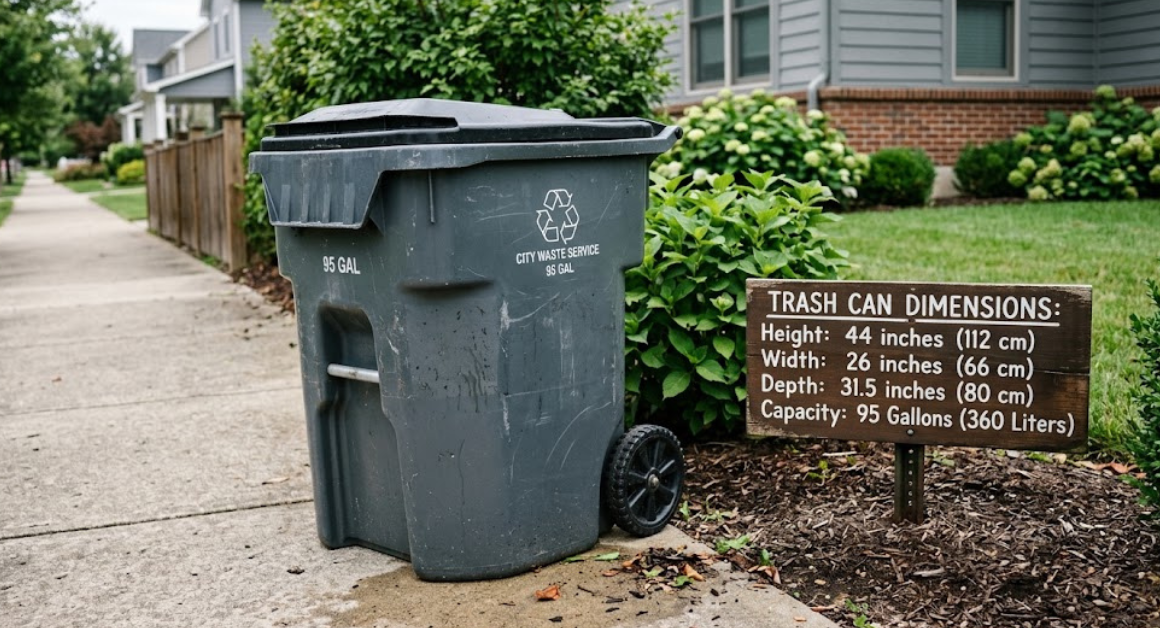
A trash can might seem like a simple household item, but finding the right size can be surprisingly tricky. One bin fits neatly beside the kitchen counter, while another with the same advertised capacity may be too wide, too tall, or awkward to fit beneath a cabinet.
Understanding trash can dimensions helps you choose a bin that works for your available space and everyday needs. You need to consider more than capacity: height, width, depth, lid clearance, and the shape of the container all affect how well it fits.
In this guide, we’ll compare common trash can sizes in inches, centimeters, and gallons, explain the dimensions of standard kitchen and outdoor bins, and show you how to measure your space before buying.
Standard Trash Can Dimensions at a Glance
Trash cans are available in a wide range of sizes, from compact bathroom wastebaskets to large wheeled outdoor carts. The dimensions below are practical estimates for common household and outdoor formats, not universal manufacturing standards. Actual measurements vary by brand and design.
| Trash can type | Approximate capacity | Typical height | Typical width or diameter |
|---|---|---|---|
| Mini bathroom bin | 1–2 gallons | 8–12 inches | 6–9 inches |
| Small bathroom bin | 3–5 gallons | 10–16 inches | 8–12 inches |
| Office wastebasket | 5–7 gallons | 14–20 inches | 10–13 inches |
| Compact kitchen bin | 7–10 gallons | 18–24 inches | 12–15 inches |
| Standard kitchen bin | 12–13 gallons | 24–28 inches | 14–17 inches |
| Medium utility bin | 20–23 gallons | 25–32 inches | 15–23 inches |
| Large outdoor bin | 32 gallons | 30–37 inches | 20–27 inches |
| Wheeled outdoor cart | 64 gallons | 40–45 inches | 24–30 inches |
| Large wheeled outdoor cart | 96 gallons | 43–48 inches | 26–34 inches |
These are general planning ranges. Some models fall outside them, and the listed width for round cans may refer to diameter. Wheeled carts can also have handles, wheels, or lids that extend beyond the main body.
For a more accurate fit, always check the manufacturer’s product specifications. For example, United Solutions lists a 32-gallon wheeled trash can with outside dimensions of approximately 22.38 × 20.98 × 33.46 inches.
What Are the Standard Kitchen Trash Can Dimensions?
For many US households, a 13-gallon kitchen trash can is a familiar choice. Thirteen US gallons is approximately 49.2 liters, and cans in this capacity range commonly stand around 24–28 inches tall.
A representative rectangular kitchen bin may measure roughly:
- Height: 24–28 inches (61–71 cm)
- Width: 14–17 inches (36–43 cm)
- Depth: 11–15 inches (28–38 cm)
- Capacity: Around 13 US gallons (49 liters)
These figures are useful for planning, but they are not a guarantee that every 13-gallon bin will fit the same space. A narrow rectangular can and a wide pedal-operated model can have very different outside measurements despite holding similar amounts of waste. <Cite refs={[“turn590544search1″,”turn590544search14”]}/>
13-gallon trash can dimensions
The 13-gallon bin is popular for kitchen waste because it offers a useful balance between capacity and footprint. It can accommodate everyday packaging, food wrappers, and other household rubbish without needing to be emptied as frequently as a smaller bin.
Before purchasing one, check these details:
- Closed height: Make sure the bin fits beneath any nearby counter or shelf.
- Lid-open height: A pedal or sensor model may need substantially more vertical clearance when open.
- Width and depth: Check the narrowest part of the available space, including nearby cabinet doors.
- Bag compatibility: Confirm that your chosen trash bags fit the bin’s opening and depth.
One manufacturer example illustrates why lid clearance matters: iTouchless lists a 13-gallon sensor can measuring approximately 27.3 inches tall when closed and 35.7 inches with its lid open. <Cite refs={[“turn590544search1”]}/>
10-gallon trash can dimensions
A 10-gallon trash can is a practical alternative for a smaller kitchen, apartment, pantry, or recycling station. Many models are shorter or narrower than standard 13-gallon bins, although the exact proportions depend on the shape.
A rough planning estimate is 18–24 inches tall, 12–15 inches wide, and 10–13 inches deep. Treat these figures as a starting point rather than a guaranteed fit.
20-gallon trash can dimensions
A 20-gallon trash can is better suited to a busy household, utility room, workshop, or area that produces more waste than a small kitchen bin can handle.
Depending on its design, a 20-gallon container may stand around 25–32 inches tall. Its width and depth can vary considerably, especially when comparing round containers with rectangular or wheeled models.
Measure the complete outside dimensions before placing a larger bin against a wall or beside an appliance.
Bathroom Trash Can Dimensions
Bathroom wastebaskets generally have a smaller capacity because they collect tissues, packaging, and other lightweight rubbish rather than large volumes of household waste.
Common bathroom trash can dimensions include:
| Capacity | Approximate height | Approximate width or diameter |
|---|---|---|
| 1–2 gallons | 8–12 inches | 6–9 inches |
| 3 gallons | 10–14 inches | 8–10 inches |
| 4–5 gallons | 12–16 inches | 9–12 inches |
| 6–7 gallons | 14–20 inches | 10–13 inches |
These measurements are estimates, not fixed standards. Simplehuman, for example, offers compact bins ranging from a 1.5-liter mini can to larger bathroom and household models, demonstrating how much sizes can differ even within one product range.
What size bathroom trash can should you choose?
A 1–3-gallon bin usually works well in a small bathroom or beside a vanity. A 4–5-gallon model may be more convenient for a larger bathroom or shared space.
Think about where the bin will sit, too. A round bin can be easy to move, while a slim or rectangular design may fit better beside a toilet or cabinet.
If the bin will sit beneath a sink, measure around the plumbing and any cabinet supports instead of relying on the cabinet’s advertised outside size.
Office Trash Can Dimensions
Office wastebaskets typically hold paper scraps, wrappers, tissues, and other dry rubbish. Because these items are often lightweight, the bin’s shape and opening can matter as much as its capacity.
A typical small office bin holds around 5–7 gallons and may be approximately 14–20 inches tall, with a width or diameter of 10–13 inches.
For a desk-side bin, consider:
- Footprint: It should fit beneath or beside the desk without interfering with your legs.
- Opening size: A wider opening makes it easier to discard paper and packaging.
- Shape: Rectangular bins can use space efficiently along a wall or desk.
- Capacity: A smaller bin works for occasional use, while a shared office may need a larger container.
For offices with recycling, separate bins can make sorting paper and general waste easier.
Outdoor Trash Can Dimensions
Outdoor trash cans are usually larger and more durable than indoor wastebaskets. They may need to hold several days of household rubbish, yard waste, or waste from a workshop or garage.
The most important measurements are the container’s height, footprint, lid size, and—if applicable—the space occupied by its wheels and handles.
32-gallon trash can dimensions
A 32-gallon bin is a common size for outdoor or utility use. Its capacity is approximately 121 liters.
A typical container may stand around 30–37 inches tall, with a width or diameter of approximately 20–27 inches. The precise dimensions depend on whether the bin is round, rectangular, or wheeled.
For a real-world example, United Solutions lists one injection-molded 32-gallon model at 26.50 inches long, 22 inches wide, and 30.75 inches high. Its wheeled 32-gallon model measures approximately 22.38 × 20.98 × 33.46 inches.
The difference shows why it is important to check the exact product rather than assuming all 32-gallon bins have identical dimensions.
64-gallon trash can dimensions
A 64-gallon outdoor cart holds approximately 242 liters. It is useful for households that need more capacity than a smaller outdoor bin provides.
Many carts in this category are around 40–45 inches tall, but overall width and depth vary. Wheels, handles, and hinged lids can increase the space required.
Before buying one, consider where it will be stored and how it will move through gates, pathways, and other narrow areas.
96-gallon trash can dimensions
A 96-gallon cart holds approximately 363 liters and is designed for substantial outdoor waste collection.
A planning estimate is around 43–48 inches in height, with a broad footprint that may measure roughly 26–34 inches across at its widest point. These dimensions are not universal, so check the model’s specification sheet.
A large cart can be useful for a busy household, but it also needs enough room for the lid to open and for the wheels to move freely.
Trash Can Dimensions in Inches and Centimeters
If you’re shopping online, you may see measurements listed in inches, centimeters, or millimeters. Converting them makes it easier to compare products from different manufacturers.
| Inches | Centimeters | Millimeters |
|---|---|---|
| 8 in | 20.32 cm | 203.2 mm |
| 10 in | 25.40 cm | 254 mm |
| 12 in | 30.48 cm | 304.8 mm |
| 15 in | 38.10 cm | 381 mm |
| 18 in | 45.72 cm | 457.2 mm |
| 24 in | 60.96 cm | 609.6 mm |
| 30 in | 76.20 cm | 762 mm |
| 36 in | 91.44 cm | 914.4 mm |
To convert inches to centimeters, multiply the measurement by 2.54.
For example, a trash can that measures 25 inches tall is 63.5 centimeters tall. To convert centimeters to inches, divide the centimeter measurement by 2.54.
How Do Trash Can Dimensions Differ by Shape?
Two trash cans with the same capacity may occupy very different amounts of floor space. That is because capacity measures the volume inside the container, not its outside dimensions.
Rectangular trash cans
Rectangular bins can sit neatly beside cabinets, walls, and appliances. Their flat sides often make them a practical choice for kitchens and narrow storage areas.
Check both width and depth: a rectangular bin may be narrow from side to side but extend farther into the room.
Round trash cans
Round bins are easy to position in open spaces and utility rooms. Their main footprint measurement is the diameter, which is the distance straight across the circular body.
To estimate whether a round bin will fit, compare its widest outside diameter with the available floor space.
Slim trash cans
Slim bins are designed for tight spaces, such as the gap beside a refrigerator or a narrow section of a kitchen. They may be relatively tall while remaining narrow from front to back.
Check the lid’s movement and the opening at the top, especially if the bin will be positioned beside a wall.
Step and sensor trash cans
Pedal-operated and sensor bins can require more clearance than basic open-top containers. The lid may extend upward or backward when opened, and a sensor model may need unobstructed space above the lid.
If the bin will be placed under a countertop, compare both the closed and fully open dimensions before making a decision.
How to Measure for the Right Trash Can
Measuring before you shop is the easiest way to avoid buying a bin that doesn’t fit.
Step 1: Measure the available height
Measure from the floor to the lowest obstruction above the intended location. This might be a countertop, cabinet shelf, or sink plumbing.
If you’re considering a lidded can, make sure you know whether the lid can open fully within that space.
Step 2: Measure the width and depth
For a rectangular space, measure the usable width from side to side and the depth from front to back.
For a round bin, check the available diameter. Include handles, pedal projections, and other parts that extend beyond the main body.
Step 3: Account for doors and drawers
A can may fit inside a gap but still prevent a nearby cabinet door or drawer from opening. Check the surrounding space and consider how you will remove a full bag.
Step 4: Check the trash bag size
The bag needs to fit over the rim and reach far enough down into the container. A bag’s advertised capacity is a useful guide, but the bag’s actual dimensions and the can’s shape also matter.
Step 5: Leave a little extra room
Avoid choosing a bin that fits with absolutely no clearance. A small amount of extra space makes it easier to remove, clean, and reposition the container.
For a pull-out bin, measure the inside of the cabinet and the usable opening—not just the outside width of the furniture.
Trash Can Capacity: Gallons vs. Liters
Trash can capacity is commonly expressed in US gallons or liters. Knowing the conversion helps when comparing products sold in different markets.
| US capacity | Approximate metric capacity | Common use |
|---|---|---|
| 1 gallon | 3.8 liters | Mini wastebasket |
| 3 gallons | 11.4 liters | Small bathroom bin |
| 5 gallons | 18.9 liters | Bathroom or office |
| 10 gallons | 37.9 liters | Compact kitchen or recycling |
| 13 gallons | 49.2 liters | Standard household kitchen |
| 20 gallons | 75.7 liters | Utility or high-use area |
| 32 gallons | 121.1 liters | Outdoor or garage bin |
| 64 gallons | 242.3 liters | Large outdoor cart |
| 96 gallons | 363.4 liters | High-capacity outdoor cart |
Conversions use US liquid gallons. Imperial gallons used in some other measurement systems are different.
One important point: a larger gallon rating does not automatically mean a taller or wider bin. A narrow, tall container and a short, wide container can hold similar volumes.
How to Choose the Right Trash Can Size
The best size depends on how much waste you produce, how often you want to empty the bin, and where it will sit.
Use these practical guidelines:
- For a small bathroom: Start with a 1–3-gallon wastebasket.
- For a home office: A 3–7-gallon bin is often a useful starting point.
- For a typical kitchen: Consider a 10–13-gallon container, then confirm the physical dimensions.
- For a busy household or utility area: A 20-gallon bin may offer more room.
- For outdoor waste collection: Compare 32-, 64-, and 96-gallon options based on your storage space and collection requirements.
Also consider how much waste your household generates. A large bin may reduce how often you empty it, but it can take up valuable floor space and become heavy when full.
If you separate recycling or compost, multiple smaller containers may work better than one oversized bin.
Frequently Asked Questions About Trash Can Dimensions
1. What are the standard trash can dimensions?
There is no single standard size for all trash cans. A typical 13-gallon kitchen bin may measure around 24–28 inches tall, 14–17 inches wide, and 11–15 inches deep, but the exact dimensions depend on the model.
2. How tall is a 13-gallon trash can?
Many 13-gallon kitchen trash cans are approximately 24–28 inches tall. Some models are taller or shorter, and pedal-operated or sensor lids may need additional clearance when open.
3. How wide is a standard kitchen trash can?
A typical rectangular kitchen bin in the 12–13-gallon range may be around 14–17 inches wide. Round bins are measured by diameter, and slim models can be narrower.
4. What size trash can fits under a kitchen sink?
The right size depends on the usable cabinet height, width, and depth, including plumbing and structural supports. Measure the actual space before buying, and check whether the lid needs to open while the bin remains inside.
5. What are the dimensions of a 32-gallon trash can?
A 32-gallon trash can may be approximately 30–37 inches tall, with a width or diameter around 20–27 inches. Exact dimensions vary by shape and manufacturer; some wheeled models are shorter or narrower than others.
6. How many liters are in a 13-gallon trash can?
Thirteen US gallons equals approximately 49.2 liters. A product labeled 50 liters may therefore be very close in capacity, though its dimensions and exact usable volume can differ.
7. Are trash can dimensions measured with the lid?
Manufacturers may list the body dimensions, overall closed dimensions, or open-lid height separately. Check the product specification to see what is included, particularly if the bin will sit beneath a counter.
8. How do I measure a round trash can?
Measure the diameter across the widest part of the body. Measure the height from the bottom to the top rim, and check any lid or handle that extends beyond the main body.
9. What size trash bags fit a 13-gallon trash can?
Tall kitchen bags are commonly sold for 13-gallon bins, but the right fit depends on the can’s rim width, height, and shape. Check the bag’s dimensions and the manufacturer’s compatibility guidance rather than relying on capacity alone.
10. Is a 13-gallon trash can the same as a 50-liter bin?
They are close in capacity: 13 US gallons is about 49.2 liters. However, a 50-liter bin may have a different shape and outside dimensions, so check the measurements if space is limited.
Conclusion
Choosing the right trash can dimensions comes down to balancing capacity with the space available. A compact bathroom bin may need only a few gallons, while a standard kitchen can often holds around 13 gallons and a large outdoor cart can hold 64 or 96 gallons.
Remember to check height, width, depth, lid clearance, and bag compatibility rather than relying on the capacity label alone. The same gallon rating can describe bins with very different shapes and footprints.
Before buying, measure the exact spot where the trash can will go and compare those measurements with the manufacturer’s specifications. If you’re also planning a kitchen upgrade or organizing a garage, comparing trash can sizes with your storage layout can help you choose a bin that fits your space and your routine.