

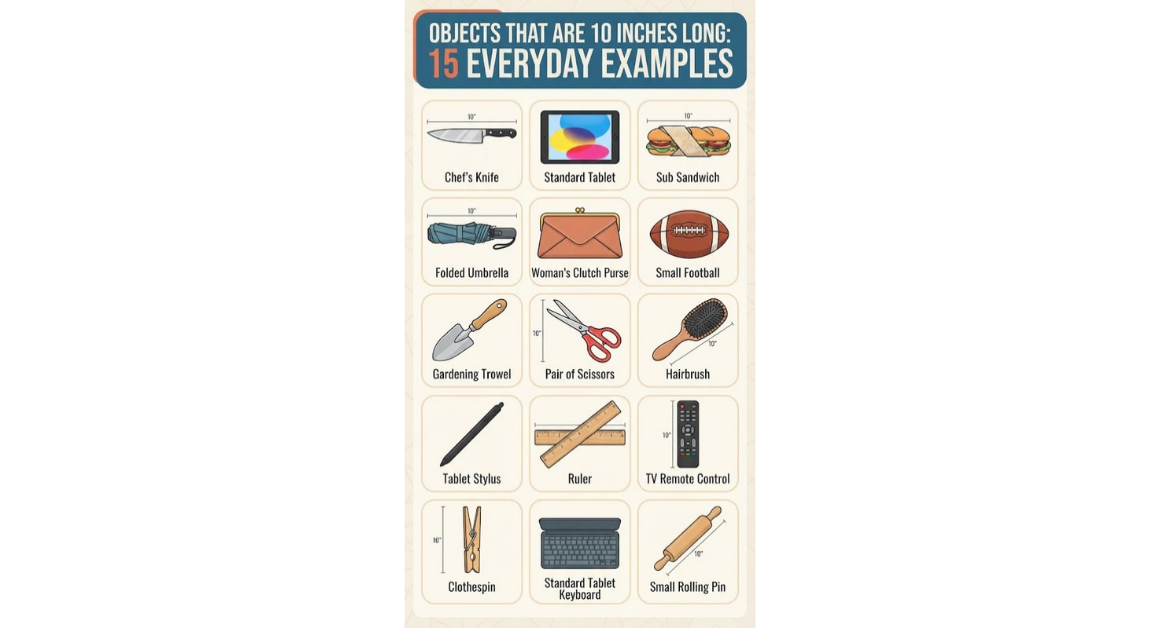
Have you ever wondered how long 10 inches really is without having a ruler nearby? Whether you’re measuring a space, shopping for a product, or simply trying to picture a specific length, familiar objects can make the measurement much easier to understand.
There are plenty of objects that are 10 inches long or close to this measurement. From kitchen utensils and household items to books and electronic devices, everyday things provide useful references for visualizing this length.
Ten inches equals 25.4 centimeters, which is slightly shorter than a standard 12-inch ruler. In this guide, we’ll explore common objects that measure approximately 10 inches, explain how to compare their sizes, and share simple ways to estimate this length without a measuring tool.
How Long Is 10 Inches?
Ten inches is equal to:
- 25.4 centimeters
- 254 millimeters
- 0.833 feet
- Approximately 0.278 yards
An easy way to visualize 10 inches is to imagine a standard 12-inch ruler with its final 2 inches removed.
<AsyncImageGroup query={[“10 inch ruler on white background measurement”,”25.4 centimeters measuring tape close up”,”10 inch object length comparison everyday objects”]} aspectRatio=”5:4″ layout=”carousel”/>
This measurement is useful for understanding the dimensions of everyday objects, including small electronics, kitchen tools, and decorative items.
15 Common Objects That Are 10 Inches Long
The following objects are useful examples of items that measure approximately 10 inches. Some have standard dimensions, while others vary by manufacturer, model, or design.
<AsyncImageGroup query={[“10 inch chef kitchen knife”,”10 inch dinner plate”,”10 inch tablet device”,”10 inch frying pan”,”10 inch hardcover book”]} aspectRatio=”5:4″ layout=”carousel”/>
1. A Standard Dinner Plate
A large dinner plate often measures around 10 inches in diameter. This makes it a convenient reference when visualizing a circular object that is approximately 25.4 centimeters across.
However, not every dinner plate has the same dimensions. Smaller plates may measure 8–9 inches, while larger serving plates can exceed 12 inches.
2. A Tablet Screen
Some tablets have screens measuring approximately 10 inches diagonally.
It’s important to understand that a tablet’s screen measurement refers to the diagonal distance from one corner to the opposite corner, not its height or width.
For example, a tablet with a 10-inch screen may have a width of around 8 inches and a height of approximately 5 inches, depending on its aspect ratio and bezels.
3. A Chef’s Knife
A 10-inch chef’s knife is a common size for professional and home kitchens.
The measurement usually refers to the blade length, not the entire knife. When the handle is included, the total length can be considerably longer.
A 10-inch blade is useful for chopping vegetables, slicing large cuts of meat, and handling other kitchen tasks.
4. A Large Frying Pan
Some frying pans measure approximately 10 inches across the cooking surface.
This measurement generally refers to the diameter of the pan’s upper rim. The handle is not included, so the complete frying pan may be considerably longer.
A 10-inch frying pan is a practical size for cooking meals for one or two people.
5. A Hardcover Book
Many large hardcover books have a height or width close to 10 inches.
Art books, photography books, cookbooks, and oversized reference books frequently use larger formats than ordinary novels.
The exact dimensions depend on the publisher, but a large hardcover book can provide a useful reference for visualizing a 10-inch length.
6. A Large Banana
A large banana can measure approximately 9–10 inches from end to end.
Banana length varies depending on the variety and ripeness. Some bananas are considerably shorter, while particularly large ones may exceed 10 inches.
A banana is a convenient household reference because it is easy to find and familiar to most people.
7. A Standard Pencil Case
Some long pencil cases measure around 10 inches in length.
These cases are designed to accommodate pencils, pens, rulers, and other stationery items. Their width and height vary considerably depending on the design.
A 10-inch pencil case is a useful example of an everyday object with a relatively consistent length.
8. A Kitchen Spatula
A long kitchen spatula may measure approximately 10 inches from the handle’s end to the tip.
Spatulas are available in a variety of lengths, with many designed for cooking, baking, and serving.
A 10-inch spatula is a convenient comparison because its straight handle makes the overall length easy to visualize.
9. A Small Laptop
Some compact laptops have a width or depth close to 10 inches.
However, laptop screen sizes are measured diagonally, and a laptop advertised as having a 10-inch screen will not necessarily be 10 inches wide.
For accurate comparisons, check the manufacturer’s listed width, depth, and height.
10. A Large Smartphone
Some older or specialized mobile devices may approach 10 inches in one dimension, but ordinary smartphones are generally much shorter.
A smartphone is therefore better used as a smaller reference object than as an exact 10-inch example.
For instance, placing two or three phones end to end can help estimate a 10-inch distance, depending on their individual lengths.
11. A Small Cutting Board
A compact kitchen cutting board may measure approximately 10 inches long.
These boards are useful for chopping fruit, preparing vegetables, and handling small food-preparation tasks.
Cutting boards come in many sizes, so check the listed dimensions if you need an exact 10-inch reference.
12. A Large Hairbrush
Some paddle hairbrushes measure close to 10 inches in overall length.
The length generally includes the handle and the brush head. Compact travel brushes are usually shorter, while larger styling brushes can be longer.
A hairbrush is another familiar object that can help you picture this measurement.
13. A Small Decorative Cushion
Some decorative cushions measure approximately 10 inches across.
These smaller cushions are commonly used on sofas, chairs, beds, or as decorative accents.
The measurement usually refers to the cushion’s width or height, rather than its thickness.
14. A Large Serving Spoon
A large serving spoon may measure around 10 inches from the tip of the bowl to the end of the handle.
Serving spoons are typically longer than ordinary teaspoons and tablespoons because they are designed to reach into serving bowls.
Their overall dimensions vary, but a large serving spoon is a practical example of an object near this length.
15. A Small Picture Frame
Some compact picture frames have an outer dimension close to 10 inches.
For example, a frame designed for a smaller photograph may measure 10 inches along one side, depending on the opening and frame thickness.
Picture frames are useful visual references because their straight edges make length comparisons easy.
Objects That Are Exactly 10 Inches vs. Approximately 10 Inches
Not every object listed above measures exactly 10 inches. Some are manufactured in standardized sizes, while others vary naturally or depend on their design.
Here’s a quick comparison:
| Object | Measurement Type | Typical Reference |
| 10-inch chef’s knife | Standardized product size | Blade length |
| 10-inch frying pan | Standardized product size | Rim diameter |
| 10-inch tablet | Standardized screen size | Diagonal |
| Dinner plate | Approximate | Diameter |
| Large banana | Variable | End-to-end length |
| Hardcover book | Variable | Height or width |
| Kitchen spatula | Variable | Overall length |
| Picture frame | Variable | Outer dimension |
The measurement method matters. A 10-inch tablet screen, for example, does not have the same physical dimensions as a 10-inch knife blade.
How to Measure 10 Inches Without a Ruler
If you don’t have a ruler or measuring tape, you can still estimate 10 inches using familiar objects.
Method 1: Use a Standard Sheet of Paper
A standard US letter-size sheet of paper measures 11 inches long and 8.5 inches wide.
The longer side is only 1 inch longer than 10 inches, making it a convenient reference.
If you need to estimate 10 inches, imagine the paper’s long edge with approximately 1 inch removed.
Method 2: Use a 12-Inch Ruler
A standard 12-inch ruler is one of the easiest tools for estimating 10 inches.
Simply identify the 10-inch mark, which is 2 inches before the ruler’s end.
Method 3: Use Your Hand
The width of an adult hand varies considerably, but it can provide a rough estimate.
Some people find that the width of their hand, measured across the palm, is around 3–4 inches. Placing a hand-width estimate two or three times along a surface may help visualize 10 inches.
For accuracy, measure your own hand once and use that measurement as a personal reference.
Method 4: Compare Everyday Objects
You can estimate 10 inches by combining smaller objects.
For example:
- Two 5-inch objects placed end to end equal 10 inches.
- Five 2-inch objects placed together equal 10 inches.
- Ten 1-inch segments equal 10 inches.
These comparisons work best when the objects are measured beforehand.
Why Knowing What Measures 10 Inches Is Useful
Understanding the size of everyday objects can help in many practical situations.
Home Organization
When arranging shelves, drawers, or storage containers, knowing what 10 inches looks like can help you estimate whether an item will fit.
For example, a 10-inch cutting board may fit comfortably in a kitchen drawer with sufficient clearance.
Shopping Online
Product descriptions often include dimensions in inches. Comparing these measurements with familiar objects can help you visualize the size before purchasing.
This is especially useful for:
- Tablets and small electronics
- Kitchen tools
- Decorative items
- Books and stationery
- Storage organizers
DIY and Craft Projects
Ten inches is a useful measurement for small woodworking projects, sewing, and decorative crafts.
Using familiar objects as references can help you estimate dimensions when a measuring tool is not immediately available.
However, always use a ruler or measuring tape for projects that require precision.
Frequently Asked Questions
1. What common objects are 10 inches long?
Common examples include large bananas, long kitchen spatulas, chef’s knife blades, some pencil cases, and certain hardcover books. Exact measurements vary by product and design.
2. Is 10 inches longer than a standard sheet of paper?
No. A standard US letter-size sheet of paper is 11 inches long and 8.5 inches wide. Ten inches is 1 inch shorter than its longest side.
3. How many centimeters is 10 inches?
Ten inches equals exactly 25.4 centimeters. This conversion is useful when comparing products that use metric measurements.
4. How can I visualize 10 inches without a ruler?
You can use the long side of a standard 11-inch sheet of paper as a reference, or compare the length with familiar objects such as a large kitchen utensil or a long pencil case.
5. Is a 10-inch tablet actually 10 inches long?
Not necessarily. Tablet screen sizes are measured diagonally from one corner to the opposite corner. The actual width and height depend on the screen’s aspect ratio and the device’s design.
6. What household item is closest to exactly 10 inches?
A product specifically sold as a 10-inch chef’s knife or frying pan is a useful reference. However, the knife measurement usually refers to its blade, while the frying pan measurement refers to its diameter.
7. How many feet is 10 inches?
Ten inches equals approximately 0.833 feet, or five-sixths of a foot. It is slightly shorter than one foot, which contains 12 inches.
8. Can I use everyday objects for accurate measurements?
Everyday objects can provide rough estimates, but their dimensions may vary. For accurate measurements, especially in construction, crafting, or product fitting, use a ruler, measuring tape, or caliper.
Conclusion
Knowing about objects that are 10 inches long makes it easier to visualize this measurement in everyday life. From a 10-inch chef’s knife and frying pan to large books, kitchen utensils, and other household items, familiar objects can help you understand how long 25.4 centimeters really is.
Remember that some objects have standardized dimensions, while others are only approximate examples. Always check the actual measurements when accuracy matters.
For more useful measurement guides, explore related articles about objects that are 5 inches, 7 inches, or 1 meter long to build a better understanding of everyday sizes.