

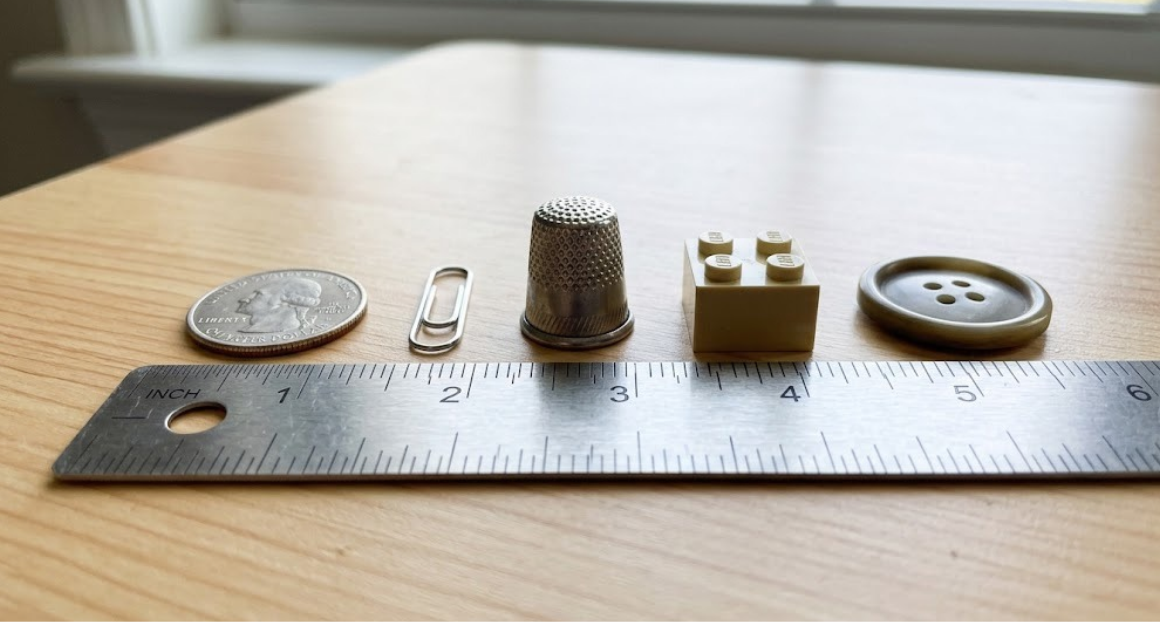
Have you ever needed to estimate one inch without a ruler? Whether you’re working on a DIY project, checking the size of a small item, helping a child with homework, or simply trying to visualize a measurement, knowing a few everyday objects that are about an inch long can make things much easier.
1 inch objects are all around us. Small household items, craft supplies, stationery, and certain coins can help you develop a better sense of this familiar unit of measurement. Although not every example measures exactly one inch, these objects provide useful reference points when you need a quick estimate.
One inch equals 2.54 centimeters, or 25.4 millimeters. Once you become familiar with this length, estimating small measurements becomes much more convenient.
How Big Is One Inch?
An inch is a unit of length commonly used in the United States and a few other countries. It is part of the imperial and US customary measurement systems, and it is frequently used to describe the dimensions of household objects, screens, tools, and clothing.
Here are the basic conversions:
| Measurement | Equivalent |
| 1 inch | 2.54 centimeters |
| 1 inch | 25.4 millimeters |
| 1 inch | 0.0833 feet, approximately |
| 12 inches | 1 foot |
| 36 inches | 1 yard |
A simple way to picture an inch is to imagine a little more than two and a half centimeters on a ruler. It is a relatively short distance, but it can make a noticeable difference when measuring small objects or completing detailed work.
25 Everyday Objects That Are About 1 Inch Long
The following examples can help you visualize one inch without reaching for a measuring tool. Keep in mind that actual dimensions vary by brand, design, and material, so use these objects as estimates rather than exact measuring standards.
1. A Standard Paper Clip
A small standard paper clip is a useful reference for visualizing an inch. Some smaller paper clips measure close to one inch in overall length, while larger varieties can be considerably longer.
Check the specific clip before using it as a measurement reference.
2. A Small Button
Many buttons used on shirts, children’s clothing, and craft projects measure around one inch across or less. A relatively large shirt button may provide a convenient visual comparison.
Buttons come in different sizes, so measure one if accuracy matters.
3. A Small Craft Bead
Certain craft beads measure approximately one inch in diameter. These are often used for jewelry making, decorative projects, and handmade accessories.
A bead’s diameter refers to the distance across its widest circular point, not its circumference.
4. The Width of a Thumb
The width of an adult thumb near the nail or upper joint can be close to one inch. However, thumb sizes vary considerably between individuals.
Your thumb can serve as a quick personal reference, but it should not replace a ruler when precision is necessary.
5. A Small Eraser
Some compact pencil erasers are approximately one inch long or wide. They are common in pencil cases, school bags, and office drawers.
Larger rectangular erasers may measure two inches or more, so the size depends on the product.
6. A Small Refrigerator Magnet
Some small decorative magnets measure close to one inch across. Round magnets, miniature souvenir magnets, and craft magnets can be useful examples.
Remember that the magnet’s width and thickness are different measurements.
7. A Small Coin
Certain coins are close to one inch in diameter, making them useful objects to compare with a ruler. For example, a US quarter is approximately 0.955 inches in diameter, which is just under one inch.
A US quarter is therefore a helpful reference for estimating this length. Coins from other countries have different dimensions, so avoid assuming that every coin is one inch wide.
8. A Small Hair Clip
Some miniature hair clips and decorative accessories measure around one inch long. They are commonly used to secure small sections of hair or decorate hairstyles.
Larger clips, claw clips, and barrettes can be several inches long.
9. A Small Bottle Cap
Certain small bottle caps measure close to one inch across. Their exact dimensions depend on the type of bottle and the cap’s design.
The diameter of the cap is usually the most useful dimension for comparison.
10. A Small Beaded Bracelet Charm
Some small bracelet charms are approximately one inch long. These decorative pieces are available in many shapes, including hearts, stars, flowers, and initials.
Because charms have irregular shapes, measure their longest dimension when comparing them with one inch.
11. A Small Craft Pom-Pom
Miniature pom-poms used for school projects, decorations, and crafts may measure around one inch in diameter. They are soft, lightweight, and easy to find in craft stores.
Their round shape makes them useful for visualizing an approximate one-inch width.
12. A Small Wooden Craft Block
Some miniature wooden blocks are manufactured with sides measuring approximately one inch. These blocks are commonly used in educational activities, model building, and craft projects.
A one-inch cube measures one inch in length, width, and height.
13. A Small Tile Sample
Some mosaic tiles and miniature craft tiles measure about one inch along each side. They are used for decorative art, small surfaces, and hobby projects.
A square tile provides a particularly clear example because its width and length can be compared directly.
14. A Small Plastic Connector
Certain small plastic connectors used in toys, craft kits, and household products are approximately one inch long. However, connectors are manufactured in many different shapes and sizes.
Use the product’s stated dimensions when fitting components together.
15. A Short Piece of Pencil
A short pencil segment measuring one inch provides an exact visual example when cut or marked using a ruler. This is useful for classroom demonstrations and hands-on measurement activities.
Avoid cutting pencils without appropriate tools and adult supervision when needed.
16. A Small Sewing Button
Small sewing buttons can measure close to one inch in diameter, although many standard shirt buttons are considerably smaller. Larger coat buttons are more likely to approach or exceed this size.
Comparing different buttons can help children understand how objects of similar shapes can have different dimensions.
17. A Miniature Toy
Small toy accessories, miniature food pieces, and tiny figurines may have dimensions close to one inch. Their size depends on the toy’s design and intended use.
If you’re comparing toys, specify whether you mean height, width, depth, or overall length.
18. A Small Rubber Foot or Bumper
Rubber feet and adhesive bumpers used under furniture, electronics, and household equipment are available in sizes around one inch. They help prevent slipping, reduce vibration, and protect surfaces.
Some are circular, making their diameter easy to compare with a ruler.
19. A Small Craft Flower
Miniature artificial flowers used for scrapbooking, gift wrapping, and handmade decorations can measure about one inch across. Their petals may extend beyond the central portion of the flower.
For an accurate comparison, measure the widest point from one petal to the opposite petal.
20. A Small Cabinet Knob Detail
Some small decorative knobs, caps, or hardware components measure approximately one inch across. These are commonly found in furniture projects and home improvement supplies.
Do not assume the entire knob is one inch just because its face or base has that diameter.
21. A Small Piece of Modeling Clay
A one-inch ball of modeling clay is a convenient homemade reference. You can use a ruler to shape the clay to approximately one inch in diameter.
This example is particularly useful for children learning about measurement through hands-on activities.
22. A Miniature Sticker
Some decorative stickers, labels, and planner accessories measure approximately one inch across. Round stickers are especially easy to compare with a ruler.
For square stickers, check both the length and width.
23. A Small Cable Clip
Certain cable clips used to organize charging cords, computer wires, and household cables are around one inch long or wide. The size depends on the cable capacity and mounting design.
These small accessories can help you estimate dimensions when organizing a desk or workspace.
24. A Small Plastic Bead Cap
Jewelry-making supplies include bead caps and decorative end pieces in a wide range of dimensions. Some larger pieces approach one inch in their longest dimension.
Check the manufacturer’s measurements because these components can be much smaller than they appear.
25. A One-Inch Mark on a Ruler
The most dependable reference is the actual one-inch interval printed on a ruler. The distance from the zero mark to the one-inch mark represents exactly one inch when the ruler is manufactured accurately.
Using a ruler to compare everyday objects is the best way to learn which items are close to one inch and which only look similar in size.
Household Items That Can Help You Estimate One Inch
If you don’t have a ruler nearby, several everyday objects may help you make a rough estimate.
| Everyday item | How it helps |
| US quarter | Its diameter is about 0.955 inches |
| Adult thumb | The width may be close to one inch |
| Small button | Some larger buttons approach one inch across |
| Miniature craft block | Certain blocks measure one inch on each side |
| Small paper clip | Some compact clips are approximately one inch long |
| Craft pom-pom | Some miniature versions are about one inch wide |
The most reliable option on this list is the US quarter if you are familiar with its size. The other examples vary more widely, so treat them as visual guides rather than standardized measurements.
How to Measure One Inch Without a Ruler
You can estimate an inch without a measuring tool, but the method you choose will affect your accuracy.
Method 1: Use a Familiar Object
Choose a small object whose dimensions you already know, such as a US quarter. Compare the object with the item you want to measure.
This method is useful for rough estimates, although it cannot guarantee an exact result.
Method 2: Use Your Finger as a Reference
Look at the width of your thumb near the nail. If it is approximately one inch wide, you can use it to estimate small objects.
For better results, measure your thumb once with a ruler and remember its approximate width.
Method 3: Use a Smartphone Measurement Tool
Some smartphones include built-in measuring features or support augmented reality measurement apps. Depending on the device, these tools use the camera and software to estimate an object’s dimensions.
Their accuracy depends on the phone, lighting, surface, and object being measured. For small objects that require precise measurements, a physical ruler or caliper is generally preferable.
Method 4: Mark One Inch on Paper
If you have access to a ruler even briefly, draw two marks exactly one inch apart on a piece of paper. You can then use the marked distance as a reference for other objects.
This technique is convenient for craft projects, classroom activities, and simple household tasks.
Why Knowing the Size of 1 Inch Objects Is Useful
Understanding one inch is helpful in more situations than you might expect. It can make everyday tasks easier and help prevent mistakes when working with small items.
Common uses include:
- DIY and home improvement: Estimating small gaps, hardware dimensions, and decorative components.
- Crafting: Choosing beads, buttons, stickers, and other materials that fit a project.
- School activities: Teaching children about inches, centimeters, length, and measurement.
- Shopping online: Understanding product dimensions before purchasing small accessories.
- Cooking and food preparation: Visualizing small lengths when following certain preparation instructions.
- Technology and electronics: Comparing small connectors, clips, and accessories.
For professional work, furniture installation, engineering, or any task where measurements must fit precisely, use a proper measuring instrument rather than relying on visual estimates.
One Inch vs. One Centimeter: What’s the Difference?
One inch is significantly longer than one centimeter. Specifically, one inch equals 2.54 centimeters, meaning it is more than two and a half times the length of a centimeter.
Here’s a quick comparison:
| Measurement | Length in centimeters | Length in millimeters |
| 1 inch | 2.54 cm | 25.4 mm |
| 1 centimeter | 1 cm | 10 mm |
| 2 inches | 5.08 cm | 50.8 mm |
| 3 inches | 7.62 cm | 76.2 mm |
This distinction matters when reading product descriptions, following craft instructions, or comparing measurements from countries that use different systems.
For example, an item described as 1 inch long is 25.4 millimeters long, not 10 millimeters.
Tips for Choosing Accurate Measurement References
Not every small object is a dependable substitute for a ruler. If you need to estimate one inch regularly, use a few simple practices.
- Choose objects with fixed dimensions. Manufactured blocks and standardized coins are usually more consistent than body parts or handmade items.
- Check the correct dimension. An object’s height, width, depth, and diameter can all differ.
- Avoid relying on photographs alone. Perspective and image scaling can make an object look larger or smaller than it really is.
- Use a ruler for important measurements. Visual comparisons are convenient, but they are not a substitute for accurate measurement.
- Remember the metric conversion. One inch is exactly 2.54 centimeters, which makes it easy to compare imperial and metric measurements.
With a little practice, you’ll become better at estimating small distances and recognizing objects that are close to one inch.
Frequently Asked Questions About 1 Inch Objects
1. What are some common objects that are 1 inch long?
Small craft blocks, certain buttons, miniature pom-poms, and some compact paper clips can measure around one inch. A US quarter is also a useful reference because its diameter is approximately 0.955 inches.
2. How big is one inch in centimeters?
One inch equals exactly 2.54 centimeters or 25.4 millimeters. This conversion is useful when comparing product sizes or working with metric measurements.
3. Is a quarter exactly one inch wide?
No. A standard US quarter has a diameter of approximately 0.955 inches, making it slightly smaller than one inch. It is a convenient reference for estimating the length, but not an exact one-inch standard.
4. Can I use my thumb to measure one inch?
You can use your thumb to make a rough estimate if its width is close to one inch. However, thumb sizes differ between people, so this method is less reliable than using a ruler.
5. What household items are close to one inch?
Depending on their design, small buttons, paper clips, bottle caps, craft beads, and miniature decorative accessories may be close to one inch in one dimension. Always check the actual size when accuracy matters.
6. How can I measure one inch without a ruler?
You can compare an object with a familiar reference, such as a US quarter, or use a smartphone measurement tool. For a reusable reference, mark a one-inch distance on paper with a ruler and keep it for later.
7. Is one inch bigger than one centimeter?
Yes. One inch equals 2.54 centimeters, so it is more than twice as long as one centimeter.
8. What is the easiest way to visualize one inch?
The easiest method is to look at the distance between the zero and one-inch marks on a ruler. If a ruler isn’t available, a US quarter provides a useful approximate comparison.
Conclusion
Finding 1 inch objects is easier when you know what to look for. Small buttons, craft supplies, miniature blocks, compact accessories, and a US quarter can all help you develop a visual understanding of this measurement, although their actual dimensions vary.
For everyday estimates, familiar objects are convenient. When precision matters, remember that one inch equals exactly 2.54 centimeters and use a ruler or another appropriate measuring tool.
The next time you need to estimate a small distance, try comparing the object with a known reference. You may be surprised by how quickly you develop a better sense of one inch.