

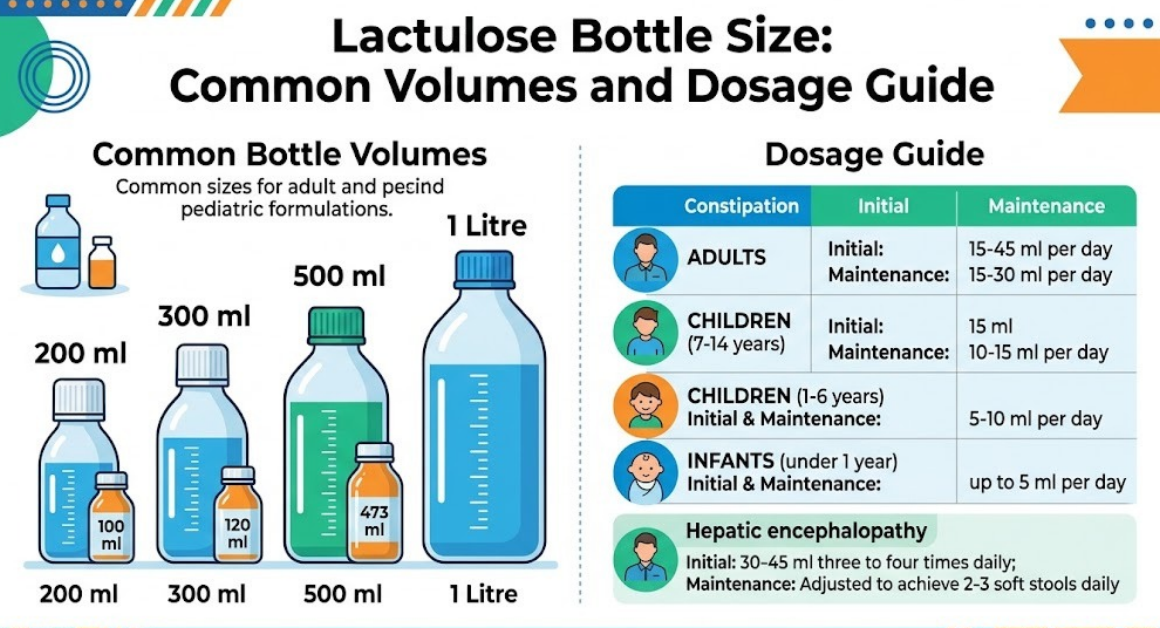
When buying medicine for constipation, the bottle size matters more than you might think. If you’re looking for the right lactulose bottle size, you’ll usually find lactulose oral solution in several package volumes, depending on the manufacturer, brand, and country. Choosing the right size can help you avoid running out too soon or purchasing more medicine than you need.
Lactulose is a commonly used laxative that helps soften stools and make bowel movements easier. It is available as a liquid syrup, making it useful for adults and children when prescribed or recommended by a healthcare professional. However, bottle sizes and recommended doses can vary, so it’s important to understand the differences before buying or using it.
What Is the Standard Lactulose Bottle Size?
Lactulose oral solution is commonly sold in bottles containing 100 mL, 200 mL, 300 mL, 450 mL, and 500 mL, although availability depends on the product and local market. Some manufacturers also offer larger containers or other package sizes.
The bottle size indicates the total volume of liquid inside, not the amount you should take in one dose.
Common lactulose bottle sizes include:
| Bottle size | Typical use |
| 100 mL | Smaller supply or short-term use |
| 200 mL | Moderate supply for an individual |
| 300 mL | Longer supply, depending on dosage |
| 450 mL | Larger supply for ongoing treatment |
| 500 mL | Larger household or individual supply |
These are examples of commonly encountered package volumes, not a guarantee that every size is available for every brand. Always check the product label or ask a pharmacist about the specific lactulose formulation sold in your area.
Which Lactulose Bottle Size Should You Buy?
The most suitable lactulose bottle size depends on how much medicine you need, how frequently you take it, and the treatment period recommended by your healthcare professional.
100 mL or 200 mL bottles
Smaller bottles may be convenient when you need a limited supply or are starting treatment. They are also easier to store and carry than larger containers.
However, a smaller bottle may not last long if your prescribed daily dose is relatively high. Check the volume required for your treatment before deciding.
300 mL bottles
A 300 mL bottle can provide a middle-ground option for people who need lactulose for several days or longer. Whether it is sufficient depends on the prescribed dose and how many times per day the medicine is taken.
450 mL or 500 mL bottles
Larger bottles may be practical for people who require ongoing treatment for constipation or another condition for which lactulose has been prescribed. They can reduce the frequency of purchasing replacement bottles.
Before buying a larger bottle, check its expiry date, storage instructions, and whether you are likely to use the medicine within the recommended period after opening.
How Long Does a Lactulose Bottle Last?
A lactulose bottle’s duration depends on its volume and the amount taken each day. You can estimate how long a bottle will last by dividing its total volume by your daily consumption.
Formula:
Bottle duration in days = Bottle volume in mL ÷ Daily amount in mL
For example, if you take 15 mL twice daily, your total daily consumption is 30 mL.
| Bottle size | Daily use | Approximate duration |
| 100 mL | 30 mL | 3.3 days |
| 200 mL | 30 mL | 6.7 days |
| 300 mL | 30 mL | 10 days |
| 450 mL | 30 mL | 15 days |
| 500 mL | 30 mL | 16.7 days |
These calculations are estimates. They assume the bottle contains the stated volume and do not account for liquid left in the bottle or minor measuring losses.
Do not change your dose simply to make the bottle last longer. Follow the directions provided by your doctor, pharmacist, or product label.
What Is Lactulose Syrup Used For?
Lactulose is an osmotic laxative commonly used to treat constipation. It works by drawing water into the bowel, helping soften stools and making them easier to pass.
Doctors may also prescribe lactulose to help manage hepatic encephalopathy, a complication of severe liver disease in which toxins affect brain function. In this situation, dosing and monitoring differ from ordinary constipation treatment, and medical supervision is essential.
Common reasons lactulose may be used include:
-
Relieving constipation.
-
Softening hard stools.
-
Supporting regular bowel movements when recommended by a healthcare professional.
-
Managing hepatic encephalopathy under medical supervision.
Lactulose is not an immediate-acting laxative. For constipation, it may take around 24–48 hours or sometimes longer to produce an effect.
How Much Lactulose Should You Take?
The correct dose depends on your age, the condition being treated, your response to treatment, and the particular product you are using.
For constipation, commonly used adult starting doses are often around 15–30 mL per day, although some product labels recommend different ranges or divided doses. Children should receive lactulose according to age-appropriate product instructions and professional advice.
For hepatic encephalopathy, doses may be substantially different and must be guided by a healthcare professional.
Keep these points in mind:
-
Read the instructions on your specific bottle.
-
Measure the liquid with an appropriate medicine cup or oral syringe rather than an ordinary kitchen spoon.
-
Drink enough fluids unless your healthcare professional has advised you to restrict fluids.
-
Do not take extra doses because the medicine has not worked immediately.
-
Seek medical advice if constipation persists or symptoms worsen.
Lactulose can cause bloating, gas, abdominal discomfort, and diarrhea. Excessive use can lead to dehydration and electrolyte disturbances.
Does Lactulose Come in Different Strengths?
Lactulose oral solution is commonly supplied at a concentration of approximately 10 g per 15 mL, equivalent to about 667 mg/mL. Some labels express the concentration differently, so check the exact formulation on the package.
Bottle size and medicine strength are two separate things:
-
Bottle size: The total amount of liquid, such as 200 mL or 500 mL.
-
Concentration: The amount of lactulose in a given volume of liquid.
-
Dose: The amount of liquid or active ingredient taken at one time.
For example, two bottles may each contain 200 mL but have different concentrations. They should not automatically be treated as interchangeable.
Always check the product name, concentration, and dosing instructions when purchasing a replacement bottle.
How Should You Store an Opened Lactulose Bottle?
Proper storage helps maintain the medicine’s quality throughout its intended shelf life.
Follow the manufacturer’s instructions, including any specific advice about refrigeration or storage after opening. Many lactulose products are stored at room temperature, away from excessive heat and direct sunlight.
For safe storage:
-
Keep the cap tightly closed after each use.
-
Store the bottle out of the reach of children.
-
Use a clean measuring device.
-
Check the expiry date before taking the medicine.
-
Follow any instructions about how long the product can be used after opening.
Do not use the medicine if its packaging is damaged or you suspect contamination. Ask a pharmacist if you are uncertain whether an opened bottle is still suitable for use.
What to Check Before Buying Lactulose Syrup
Before choosing a lactulose bottle size, check more than just the volume printed on the package.
-
Product concentration: Confirm that it matches your prescription or previous product.
-
Bottle volume: Choose a size that suits your expected treatment needs.
-
Expiry date: Make sure the medicine will remain within its expiry period.
-
Manufacturer and packaging: Buy from a licensed pharmacy or reputable supplier.
-
Storage requirements: Check how the bottle should be stored, especially after opening.
-
Price per mL: Comparing the price per milliliter can help you evaluate different package sizes.
If you take lactulose regularly, a larger bottle may be convenient. However, the cheapest option is not necessarily the best if the product will expire before you finish it.
Frequently Asked Questions About Lactulose Bottle Size
1. What is the most common lactulose bottle size?
Lactulose is available in several package sizes, including 100 mL, 200 mL, 300 mL, 450 mL, and 500 mL in some markets. The most common size varies by brand, country, and pharmacy.
2. Is lactulose available in a 500 mL bottle?
Yes, some manufacturers offer lactulose in 500 mL bottles. Availability depends on the specific brand and local market, so check with a pharmacist.
3. How many days does a 200 mL lactulose bottle last?
If you take 30 mL daily, a 200 mL bottle lasts approximately 6.7 days. At 15 mL daily, it lasts approximately 13.3 days. Your actual treatment duration depends on your prescribed dose.
4. Can I buy a larger lactulose bottle to save money?
A larger bottle may offer a lower price per milliliter, but compare prices and check the expiry date and storage instructions. Make sure the product’s concentration matches your prescribed medicine.
5. Does lactulose bottle size affect the dose?
No. The bottle size indicates the total volume available, while the dose is the amount taken at one time. Your dose should be determined by the product instructions and your healthcare professional, not by the size of the bottle.
6. Can children use lactulose syrup?
Lactulose may be used in children when appropriate, but the dose depends on age and clinical circumstances. Consult a healthcare professional and follow the specific product’s instructions rather than applying an adult dose.
7. How long does lactulose take to work?
Lactulose commonly takes 24–48 hours to help relieve constipation, although it may take longer for some people. Do not increase your dose without professional advice if it does not work immediately.
8. Should lactulose be refrigerated after opening?
Not necessarily. Storage requirements vary by product, and many lactulose solutions can be stored at room temperature. Follow the instructions printed on your bottle or ask a pharmacist.
Conclusion
Choosing the right lactulose bottle size depends on your prescribed dose, expected treatment duration, and the package sizes available locally. Bottles ranging from 100 mL to 500 mL are examples of options you may encounter, but the exact selection varies by manufacturer and market.
Before purchasing lactulose, confirm the concentration, expiry date, storage requirements, and recommended dosage. If you are unsure which size or formulation is appropriate, a pharmacist can help you select the right product for your needs.